

Last updated: November 2026
Quick answer: The correct EV tyre pressure in Singapore is the cold pressure printed on your car’s door-jamb placard, not the maximum figure on the tyre sidewall. Check it monthly and before long drives, first thing in the morning before driving. Underinflated EV tyres wear faster, heat up more and cut your range.
Getting your EV tyre pressure right in Singapore is one of the cheapest things you can do for your car. Electric vehicles are heavier than similar petrol cars, deliver instant torque and depend on low rolling resistance for range. All three make pressure more important, not less. At Motion EV Tyre by Motoserv, under-inflation is one of the most common issues we see when EV owners come in for a tyre check. Here is what Singapore EV drivers should know.
What is the correct EV tyre pressure in Singapore?
Use the cold inflation pressure on the placard inside the driver’s door jamb (or in your owner’s manual), not the number moulded on the tyre. The sidewall figure is the tyre’s maximum safe pressure, not the recommended running pressure.
Many EVs specify higher pressures than drivers are used to. Some models, including the Tesla Model 3, list pressures in the low 40s psi on the placard. Others list front and rear pressures separately, or give a higher “full load” figure. Pressures may be shown in psi, kPa or bar, so make sure your gauge or pump uses the same unit.
If you have changed to a different wheel or tyre size, the original placard may no longer be correct. Ask a tyre specialist to confirm the right pressure for the new set-up.
Why does tyre pressure matter more on an EV?
EVs put more stress on their tyres, so the effect of wrong pressure shows up sooner. Three things are different:
- Weight. Battery packs make EVs heavier than comparable petrol cars. Under-inflated tyres flex more under that load, which builds heat and wears the shoulders faster.
- Instant torque. Strong acceleration from a standstill already wears EV tyres harder. Soft tyres make it worse.
- Range. Tyre makers such as Michelin note that correct inflation helps keep rolling resistance low, which supports driving range. A tyre running below its recommended pressure takes more energy to roll.
EV-specific tyres such as the Michelin e.Primacy, Hankook iON and Continental EV ranges are designed for low rolling resistance. Running them under-inflated wastes much of that benefit.
How does Singapore’s heat and rain affect EV tyre pressure?
Heat raises tyre pressure temporarily, while slow air loss lowers it over time. Both can fool you if you check at the wrong moment.
- Check cold. After driving, or after the car has been parked in the afternoon sun, pressure reads higher than the real cold figure. Check in the morning or after the car has been parked in the shade for a few hours.
- Don’t let air out of hot tyres. If a hot tyre reads above the placard, that is normal. Releasing air leaves it under-inflated once it cools.
- Monsoon season. During the northeast monsoon (roughly November to March), correct pressure helps the tread keep its shape and clear water. Under-inflated tyres are more likely to aquaplane on flooded expressway lanes. See our EV tyre buying guide for more on wet grip.
How often should I check my EV tyre pressure?
Check at least once a month and before any long trip, such as a drive into Malaysia. Tyres naturally lose a little air over time, even without a puncture.
Your TPMS (tyre pressure monitoring system) will warn you when pressure drops significantly, but it is a warning system, not a replacement for regular checks. By the time the light comes on, the tyre may have been running low for some time.
Monthly EV tyre pressure checklist
| Step | What to do |
|---|---|
| 1 | Check when tyres are cold (morning, or parked in shade for 3+ hours) |
| 2 | Find the placard pressure on the driver’s door jamb |
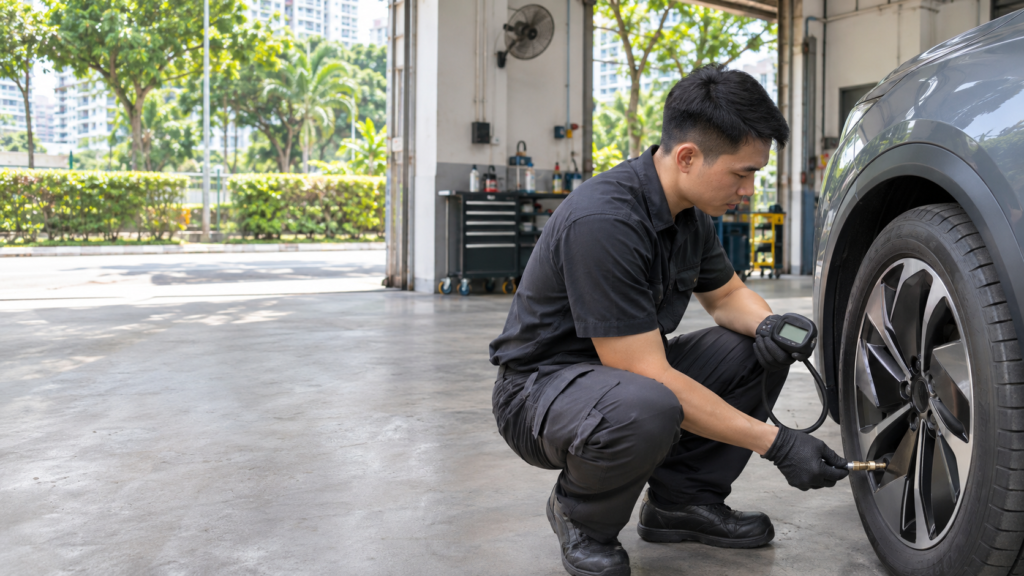
| 3 | Use a reliable gauge; don’t rely only on petrol-station pumps |
| 4 | Inflate or deflate to the placard figure, front and rear |
| 5 | Refit the valve caps to keep out dirt and moisture |
| 6 | Look at the tread and sidewalls for nails, cuts or bulges |
| 7 | If one tyre keeps losing air, have it inspected |
What happens if EV tyres are under- or over-inflated?
Both shorten tyre life and affect safety, but in different ways.
| Problem | Under-inflated | Over-inflated |
|---|---|---|
| Wear pattern | Both outer edges (shoulders) wear faster | Centre of tread wears faster |
| Grip | Sluggish steering, more heat build-up | Smaller contact patch, less grip in the wet |
| Range | Higher rolling resistance, lower range | Little range gain, harsher ride |
| Comfort | Vague handling | Firmer, noisier ride |
| Risk | Overheating and sidewall damage | More prone to impact damage from potholes |
Keep an eye on tread depth too. LTA requires a minimum tread depth of 1.6mm, and uneven wear from wrong pressure can take one part of the tread down to that limit long before the rest. You can read more on vehicle requirements at OneMotoring.
Signs you need a tyre specialist
Pumping the tyre up yourself is fine for routine top-ups. Book a professional check if you notice:
- The TPMS warning light stays on after you inflate to the correct pressure
- One tyre keeps losing air every week or two
- A nail, screw or cut in the tread or sidewall
- A bulge or crack on the sidewall
- Uneven wear across the tread (edges or centre)
- Vibration at expressway speeds, or the car pulling to one side
- A noticeable drop in range without another explanation
How Motion EV Tyre helps
Motion EV Tyre by Motoserv is an EV and hybrid tyre specialist with IMI-certified technicians. We look after Tesla, BYD, MG, BMW, Mercedes EQ, XPeng, Dongfeng and hybrid owners.
- EV tyre inspection: pressure, tread depth, wear pattern and damage check using diagnostic tools.
- TPMS service: diagnosing warning lights, faulty sensors and sensor programming.
- Tyre replacement, balancing and rotation: 100% genuine EV tyres from Michelin, Continental, Hankook iON, Giti and Toyo Proxes EV.
- Model-specific advice: see our Tesla EV tyres and BYD EV tyres pages.
If you need new tyres, contact us for a quote for your exact size.
Our outlets and opening hours
- Motoserv @ Havelock (main): 548 Havelock Rd, Singapore 169637
- Upper Bukit Timah: 219 Upper Bukit Timah Rd (Shell Autoserv), Singapore 588186
- Serangoon Gardens: 49 Serangoon Garden Way, Singapore 555944
Hours: Monday to Saturday, 9am–6pm. Closed on public holidays.
Key takeaways
- The right EV tyre pressure is the cold figure on your door placard, not the sidewall maximum.
- Check monthly and before long trips, with tyres cold. Singapore heat inflates readings after driving.
- Under-inflation wears EV tyres faster, increases heat and reduces range.
- TPMS is a warning system, not a substitute for regular checks.
- A tyre that keeps losing air or a TPMS light that won’t clear needs a specialist inspection.
Frequently asked questions
What PSI should my EV tyres be in Singapore? Use the cold pressure on the placard inside your driver’s door jamb or in the owner’s manual. It differs by model, and some EVs specify different front and rear pressures. Do not use the maximum pressure printed on the tyre sidewall.
Does tyre pressure affect EV range? Yes. Under-inflated tyres have higher rolling resistance, so the motor uses more energy to keep the car moving. Tyre makers such as Michelin advise keeping EV tyres at the recommended pressure to help protect range.
Should I check EV tyre pressure hot or cold? Always check cold, ideally in the morning or after the car has been parked in the shade for a few hours. In Singapore’s heat, readings after driving can be noticeably higher than the true cold pressure, so don’t let air out of hot tyres.
Why is my TPMS light on even though my tyres look fine? Tyres can be several psi low without looking flat, so check them with a gauge first. If the light stays on after you set the correct pressure, a sensor may be faulty, have a flat battery or need reprogramming, and a TPMS service can diagnose it.
Can I use nitrogen in EV tyres? Nitrogen can be used, but normal compressed air is fine for most drivers. What matters most is checking regularly and keeping tyres at the placard pressure, whichever you use.
Book your EV tyre check
Not sure your tyres are at the right pressure, or worried about uneven wear? Visit Motion EV Tyre by Motoserv at 548 Havelock Rd or one of our other outlets. Call +65 8220 3588 or book online, and our EV tyre team will check your pressures, tread and TPMS for you.
2 Responses